You can spot a real watch expert from across a room—not by the logo on their wrist。but by how they flip a caseback. They don't just check the rotor;they listen to the click of the crown threads, feel the resistance of the bezel, and squint at the perlage on the bridges. I once watched a certified horologist reject a $30,000 chronograph because the chronograph seconds hand stuttered at 1/10th increments. The owner was stunned. The expert simply said, 'The vertical clutch is slipping. That's a $2,000 fix, and you'll lose it again in six months.' That's the kind of granular judgment a watch expert brings—no spec sheet tells you that.Certification matters less than obsession. Yes, brands love to flash 'master watchmaker' titles from WOSTEP or SAW, and those credentials are useful. But a true watch expert spends hours on forums like WatchUSeek and r/watches, not just to argue about lug-to-lug measurements。but to track serial number patterns that reveal factory service replacements. They know that a 1960s Omega Seamaster with a replacement dial will lose 40% of its value overnight—and they can spot the telltale font difference on the 'Seamaster' script at arm's length. I've seen experts use a loupe to check the beveling on a vintage Rolex Datejust's lugs, then cross-reference the caseback engraving with a database of stolen serials. That's not on any certification exam. It's street-level knowledge, built from years of handling gray-market pieces and reading auction house fine print.Movement finishing is where a watch expert separates hype from heritage. Take the Geneva stripes on a Patek Philippe Calatrava—experts don't just admire the pattern;
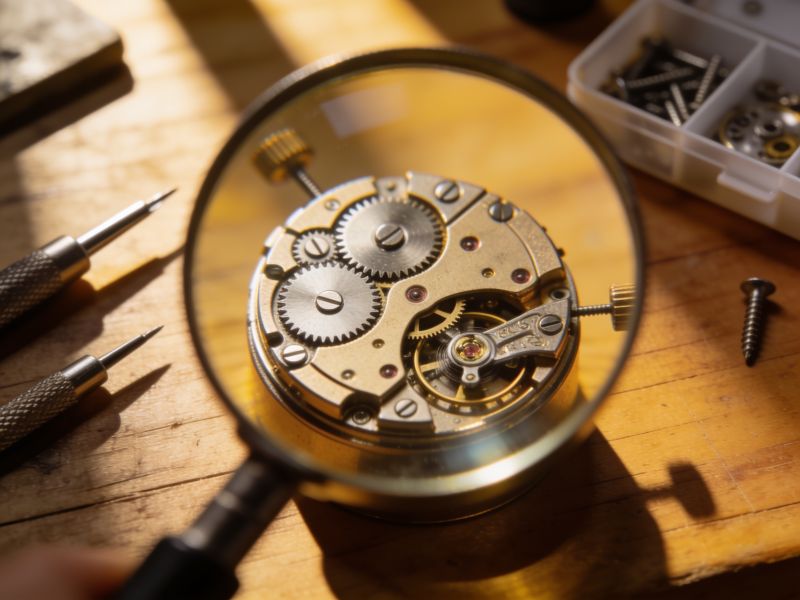
they check if the stripes are applied by hand (irregular spacing) or machine (perfectly parallel). A watch expert might spend 20 minutes under a macro lens counting the inward angles on a bridge. Fewer than six?Mass-produced. Nine or more?That's a hand-finished movement worth the premium. I remember a dealer in Zurich who refused to buy a 'mint' Vacheron Constantin because the black polish on the ratchet wheel showed micro-scratches under 10x magnification—a sign of a clumsy service. The seller argued;
the expert walked. Six months later, that same watch appeared at auction with a 'recently serviced' disclaimer. The expert's gut was right, and it came from pattern recognition, not a textbook.Dial and case details tell a story that a watch expert reads like a detective. Patina on a Rolex Submariner's bezel insert—experts call it 'ghosting'—can add or subtract thousands depending on whether it's uniform. A watch expert knows that a 'tropical' dial on a vintage Omega Speedmaster is desirable only if the brown discoloration is even. Uneven fading?That's water damage, not patina. I once saw an expert pass on a perfectly running Heuer Carrera because the lume plots on the dial had been re-lumed with modern Super-LumiNova. 'It glows like a flashlight,' he said. 'Original lume should be dead.' That single detail dropped the price by $4,000. A collector without expertise would have paid full retail for a watch that lost its soul.Ultimately, a watch expert's value isn't in memorizing caliber numbers or auction records. It's in the willingness to be wrong—and then check again. I've seen experts change their verdict on a watch after a second look with a different light source. They carry a loupe, a UV torch, and a digital caliper in their jacket pocket. They measure case thickness to the tenth of a millimeter. They ask about service history not as a formality, but as a filter for hidden problems. If you want to buy a watch without regret, find someone who has handled a thousand pieces—not just read about them. A watch expert doesn't tell you what to buy. They tell you what to avoid。and why. That's worth more than any certificate on the wall.